
See how Level Up helps your child move forward.
Where to begin, what to practice and how to get help when something is difficult. Explore the math program through the questions parents ask, with short videos showing how it works.
- Aligned to Common Core State Standards
- Built for grades K through 8
- Assessment and report inside the 7-day free trial
- Adapts to every child
- Review built into daily practice
Where does my child begin?
Your child starts with an adaptive assessment inside the free trial. It takes about 30 to 40 minutes and saves as your child goes. The answers help identify strengths and gaps across grade levels. You get a plain-language report showing where learning should begin.
- Questions adapt as your child answers
- A report that explains strengths and skills that need work
- Assessment, report and practice inside the 7-day free trial
What does daily practice look like?
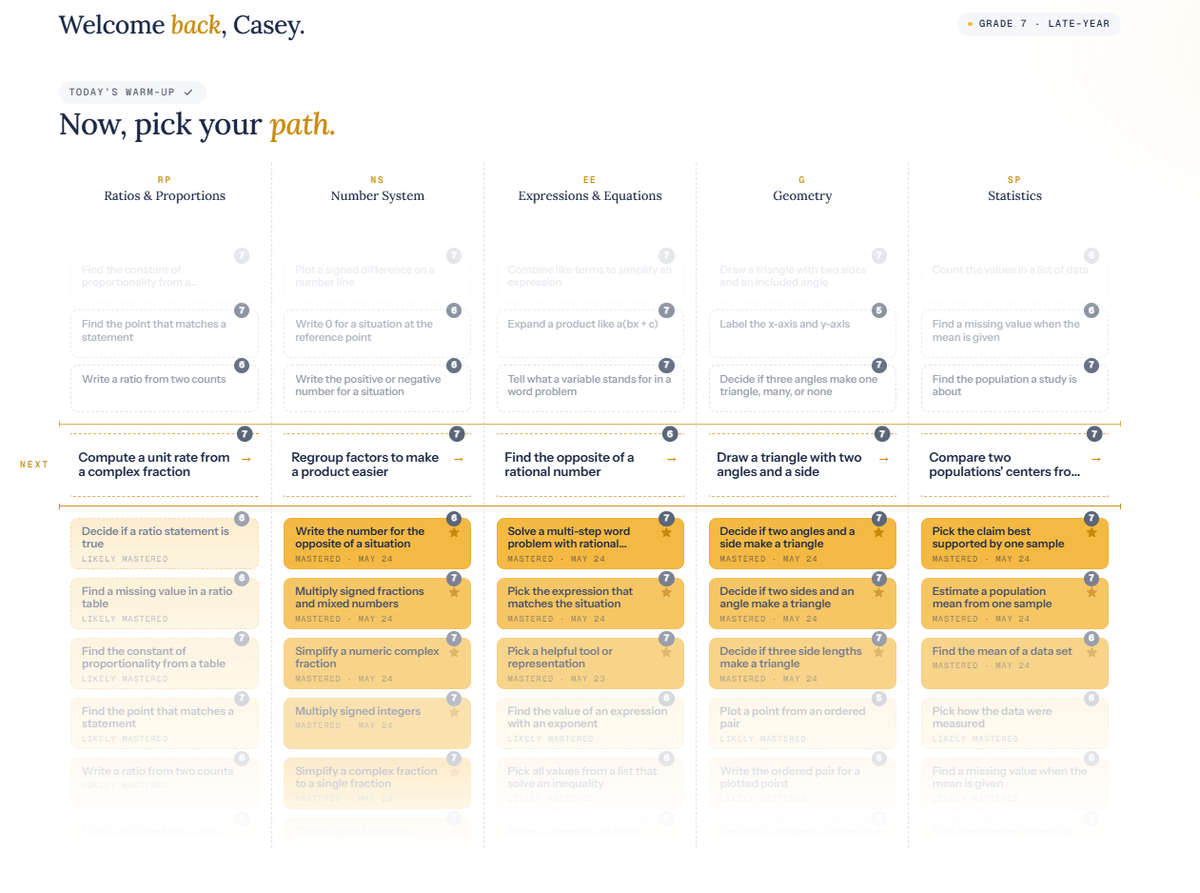
Your child can follow the practice board or choose a topic from school. Level Up uses the assessment and practice answers to choose the next work. A school-topic plan brings the topic skills and helpful supporting practice together.
- A warm-up and practice matched to your child
- School topics alongside the supporting skills your child needs
- About 30 minutes a day, 5 days a week is the recommended routine
What happens when my child gets stuck?
A wrong answer gives your child a solution to work through. If the difficulty continues, Level Up can offer a worked example, keep it beside the next try or bring in practice on an earlier skill. The original work stays on the board, with a path back to it.
- Step-by-step solutions for wrong answers
- Worked examples that can stay beside a similar problem
- Supporting practice when an earlier skill needs attention
Your child can also write to our team about a confusing question.
What helps my child keep going?
With Quests, you and your child choose a goal and a real-world reward together. Both of you sign the promise. Progress comes from mastering skills, so the reward is tied to learning.
- Choose the goal and reward together
- Quest sizes reflect your child’s current skills
- Track the signed promise and progress toward it
Sample parent dashboard
Practiced 9 of the last 14 days, 85 questions this week.
3 skills to go.
What can I see and control?
See what your child practiced, which skills are mastered and the answers behind the progress. You can check the dashboard or read the weekly email. In your child’s settings, you can also choose a daily wrap-up reminder and a stopping time.
- Inspect practice questions, answers and time spent
- See progress by math area and grade
- Optional daily reminder and stopping time, after the current question
Where Casey stands, by area
Casey · Grade 7Other apps count problems. Level Up tracks understanding.
Most math apps mark a skill complete after a set number of problems, understood or not. Level Up treats mastery as a claim that has to be earned: correct work again and again, on the harder variations too, with enough consistency that a lucky streak can never pass for understanding. When the dashboard says mastered, it is true.
- Proven across difficulty: the hard versions count, not just the easy ones
- Proven by consistency: repeated correct work, never one good run
- Every skill maps to a specific Common Core standard
- Progress only moves forward, never backward
Benjamin Bloom’s research on mastery learning found that nearly all students can reach a high level of achievement when they are given the time and support to truly master each step before moving on. Level Up is built around that idea.
We build up, never skip ahead.
Skills connect across grades. When practice shows a difficulty, those connections help Level Up choose supporting work. Practicing an earlier skill can prepare your child to return to the original one.
Each successful review pushes the next one further out. Solid skills need checking less and less; shaky ones come back sooner.
Review helps skills stay familiar.
Daily warm-ups bring back skills your child has practiced before. Successful review checks can increase the time before the next check. When a skill needs more attention, it can come back sooner.
- Review built into the daily warm-up
- Intervals respond to your child’s answers
- Earlier skills remain part of practice
Spaced repetition is built on the spacing effect, one of the most consistent findings in the science of memory: spreading practice out over time produces far stronger long-term retention than cramming it together. Level Up’s review schedule puts it to work.
Engaging, not addictive.
On purpose.
We know gamification can be done badly: endless streak guilt, leaderboards that make most kids feel like losers, and dark patterns designed to maximize screen time. We deliberately left all of that out.
There are no leaderboards and no comparing your child to anyone else. The only comparison is to where your child was yesterday. Missing a day is never punished, and the streaks and achievements are tied to real learning and individual progress. The game your child is playing is mastering math. That’s the whole point.
Safe, private, and made for kids.
The smallest footprint
Parent-led signup. From children, we collect a first name and grade level. No last names, no birthdays, no photos.
No ads, ever
Level Up carries no advertising of any kind, and we never build marketing profiles from your child’s activity.
We never sell data
Student data is never sold or shared for advertising. It exists to help your child learn, full stop.
AI that cannot learn from your child
The AI providers we use are contractually barred from training their models on your child’s data.
Aligned with COPPA and GDPR
We follow the COPPA and GDPR rules for protecting children’s privacy, and all data is encrypted in transit and at rest.
You stay in control
Review and delete your child’s data from the dashboard, or request a full export by email, at any time.